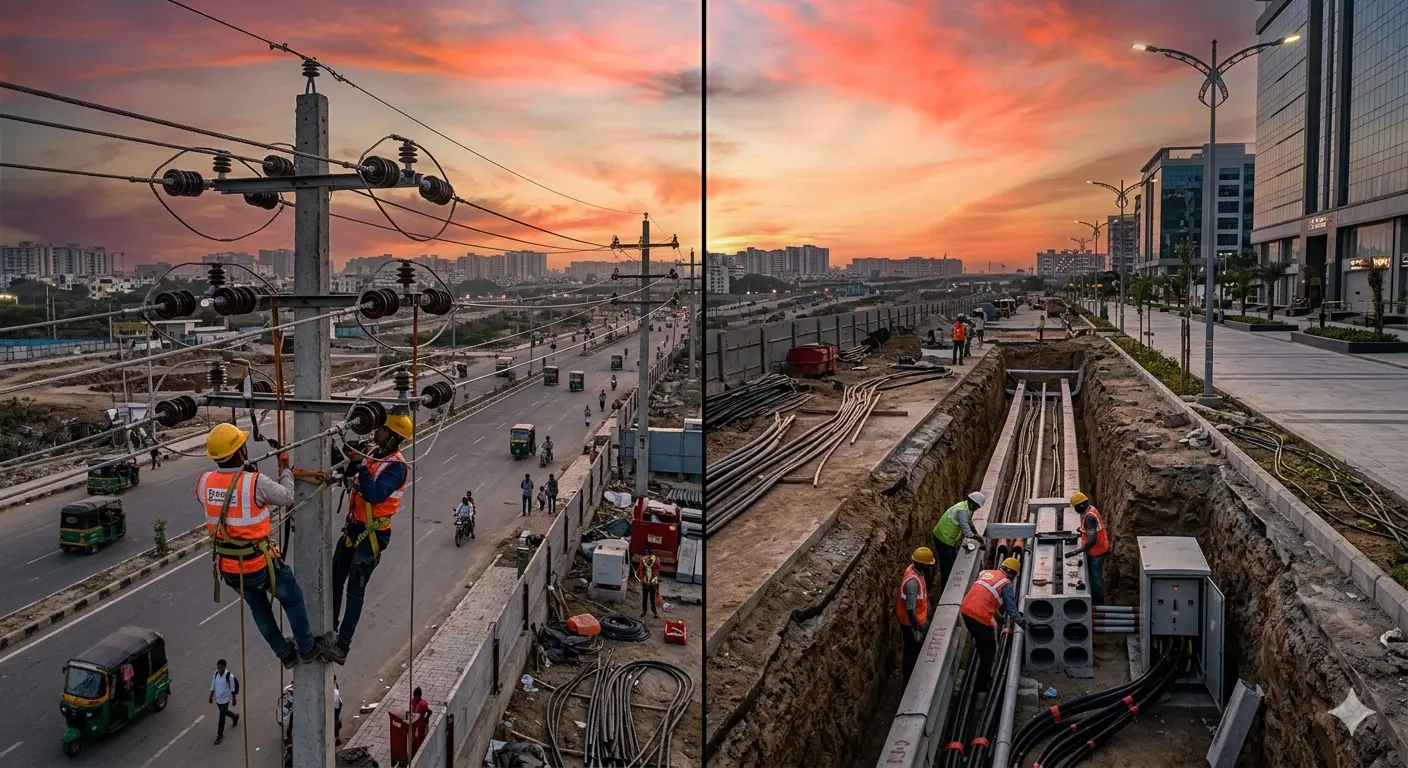
11kV Overhead vs. Underground: Choosing the Right External Electrification Path
Developing a commercial complex, high-rise township, or industrial plant requires managing dozens of moving parts. Among these, few decisions carry as much long-term financial and operational weight as your power distribution setup. When designing medium-voltage networks, the core dilemma always centers on the same technical crossroads: Should you deploy an 11kV overhead line or invest in an underground cable network?
This decision impacts your initial capital expenditure, future maintenance liabilities, structural safety, and property aesthetics. As a premier infrastructure electrical contractor, Omkar Enterprises balances these factors every day.
This guide breaks down the technical differences, cost trade-offs, and deployment parameters of External Electrification to help you make an informed choice for your next project.
What is External Electrification and Why is it Critical?
Before weighing the pros and cons of individual systems, it helps to look at the broader picture. External Electrification refers to the entire electrical infrastructure built outside the main footprint of a building. This system acts as the bridge connecting the state utility grid (DISCOM) to your local step-down transformers.
[State Utility Grid / DISCOM] │ ▼ [EXTERNAL ELECTRIFICATION] ──► (11kV Overhead Poles OR Underground Cables) │ ▼ [Substation / Step-Down Transformer] │ ▼ [Internal Power Distribution] ──► (MDBs, Panels, Facility Loads)
If this external gateway is poorly engineered, your facility will face frequent voltage drops, equipment damage, and unexpected blackouts. Partnering with an experienced HT LT electrical contractor during the master-planning phase ensures your primary power supply line is resilient, compliant with statutory safety codes, and sized correctly for future load expansions.
11kV Overhead Lines: The Classic, High-Visibility Approach
Overhead distribution uses bare conductors (like ACSR or AAAC) suspended high above the ground on steel-reinforced concrete or lattice steel poles, insulated by polymer or ceramic discs.
The Advantages
- Significantly Lower Upfront Capital: Overhead lines are highly cost-effective to install. Without the need for extensive excavation, trenching, or specialized insulation, the initial setup cost is substantially lower than underground alternatives.
- Rapid Deployment: An experienced electrical contractor in Indore can complete kilometers of overhead pooling and stringing in a fraction of the time it takes to lay underground lines.
- Easy Fault Identification: Because the entire line is completely visible, maintenance teams can quickly spot a snapped conductor, a broken insulator, or tree branch interference. This speeds up troubleshooting and minimizes downtime.
The Drawbacks
- Vulnerability to Weather: Exposed lines bear the brunt of heavy monsoons, high winds, and lightning strikes.
- Safety Risks: Public exposure increases the risk of accidental contact, flashovers, and power theft via illegal tapping.
- Aesthetic Limitations: A network of poles and sagging wires can detract from the visual appeal of modern townships, high-end commercial hubs, and smart-city layouts.
11kV Underground Cabling: The Modern, Resilient Standard
Underground distribution relies on heavily insulated, multi-core XLPE (Cross-linked Polyethylene) armored cables buried deep in the ground inside protective HDPE conduits or structured concrete duct banks.
The Advantages
- Superior System Reliability: Shielded from lightning, high winds, and falling tree branches, underground setups see a massive reduction in short circuits and transient faults compared to overhead lines.
- Maximum Public Safety: Placing medium-voltage cables underground eliminates the risk of accidental electrocution, flashovers, and phase-to-phase contact, creating a safer environment for crowded urban and industrial areas.
- Clean, Uncluttered Aesthetics: Eliminating overhead wires allows architectural designs, green zones, and streetscapes to stand out. This clean look can directly increase property values in premium real estate developments.
The Drawbacks
- High Initial Investment: Underground networks require considerable upfront capital. Trenching, purchasing heavily insulated armored cables, backfilling, and installing specialized Ring Main Units (RMUs) push costs up to 2.5 to 4 times higher than an equivalent overhead setup.
- Complicated Fault Locating: When an internal cable fault occurs, it cannot be spotted visually. Locating the issue requires specialized surge wave generators (cable thumpers) and underground time-domain reflectometers, followed by pavement cutting and excavation to make the repair.
Head-to-Head Comparison Matrix
| Technical Parameters | 11kV Overhead Line Network | 11kV Underground Cable Network |
|---|---|---|
| Initial Project Expenditure | Low to Moderate (Highly cost-effective) | High (Requires specialized cables & excavation) |
| Susceptibility to Weather | High (Exposed to storms, wind, and rain) | Exceptionally Low (Protected underground) |
| Lifespan Expectancy | 20–25 Years (Requires regular component replacement) | 35–40+ Years (Protected from ambient wear) |
| Fault Rectification Time | Fast (Minutes to hours; fully visible) | Long (Can take days to locate, dig, and splice) |
| Power Theft & Tapping Risk | High (Prone to unauthorized hookups) | Zero (Completely sealed and inaccessible) |
| Right of Way (ROW) Space | Demands wider horizontal/vertical clearances | Minimal (Follows compact road or utility paths) |
Choosing the Right Approach for Your Project
There is no one-size-fits-all solution for medium-voltage power distribution. The ideal choice depends entirely on the nature of your project, its budget, and its location:
When to Choose Overhead Lines
- Cross-Country Infrastructure: Long-distance power transmission across rural areas, farms, or open highways.
- Budget-Constrained Industrial Zones: Projects where keeping initial capital expenditure low is critical, and there is plenty of open space for safe clearances.
- Temporary Supply Networks: Construction sites or temporary setups that will be modified or removed within a few years.
When to Choose Underground Networks
- Smart Townships & Residential Sectors: Modern residential projects where clean aesthetics, reliability, and resident safety are top priorities.
- Densely Populated Commercial Hubs: Busy metropolitan areas where high foot traffic and tight structural clearances make overhead lines unsafe or impractical.
- Heavy Industrial Plants: Refineries, chemical facilities, and manufacturing plants where an uninterrupted power supply is essential to prevent costly production halts.
Partnering with Local Infrastructure Experts
Successfully executing an external power distribution project requires more than just choosing between overhead and underground systems. It demands navigating regulatory frameworks, securing utility approvals, and ensuring precise on-site engineering.
For public infrastructure and logistics projects, working with an experienced highway lighting contractor in India ensures your distribution lines seamlessly integrate with massive transit networks.
If you are developing a project within Madhya Pradesh, partnering with a qualified street light contractor in Indore guarantees that your secondary distribution lines, transformers, and public lighting grids are perfectly balanced to handle local load requirements.
Why Choose Omkar Enterprises?
- Turnkey Execution: We handle everything from initial feasibility studies and DISCOM liaisoning to trenching, line stringing, and final substation commissioning.
- Decades of Proven Expertise: Our deep experience navigating complex regional grids ensures your project stays fully compliant with Central Electricity Authority (CEA) safety guidelines.
- Tailored Engineering: We don't push generic solutions. Our team analyzes your specific load profiles, soil conditions, and budget to design the most efficient power distribution path for your facility.