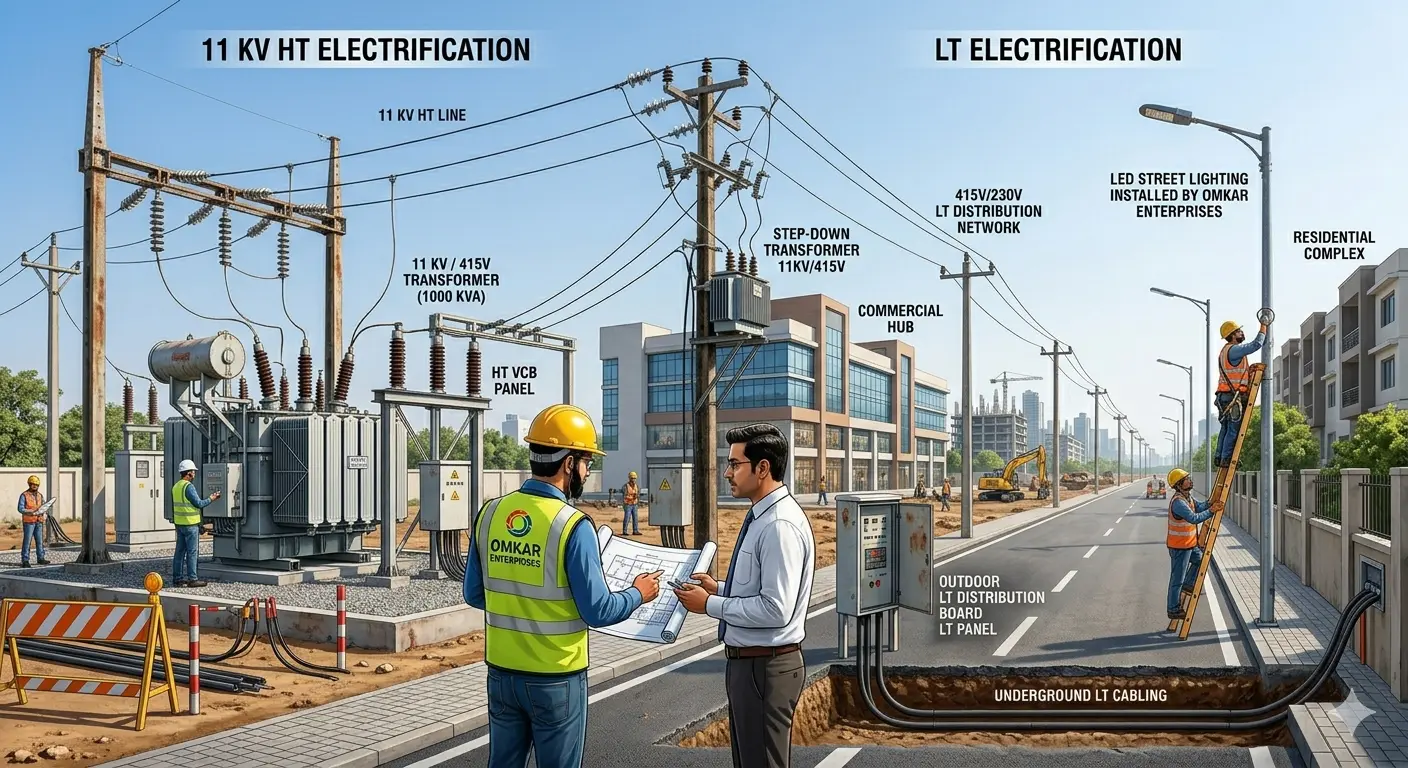
11 KV vs. LT Electrification: A Beginner’s Guide to Infrastructure Planning by a Leading HT LT Electrical Contractor
When planning a new residential township, an industrial unit, or a commercial complex, one of the most critical decisions you will face is designing the power distribution system. For many project managers, navigating the technical jargon of electrical engineering can feel overwhelming. The most common crossroads you will encounter is choosing between 11 KV (High Tension) and LT (Low Tension) Electrification.
Making the wrong choice can lead to frequent power outages, massive energy losses, and inflated electricity bills. As an experienced HT LT Electrical Contractor, Omkar Enterprises has put together this beginner-friendly guide to help you make an informed decision for your next infrastructure project.
Understanding the Basics: What is HT and LT Electrification?
Before diving into the comparison, let’s break down what these terms actually mean in the realm of power distribution.
- 11 KV (High Tension / HT) Electrification: This refers to high-voltage electricity transmission. "KV" stands for Kilo-Volt, so 11 KV equals 11,000 volts. Industrial plants, large commercial complexes, and massive residential townships typically tap directly into the grid at this voltage level.
- LT (Low Tension) Electrification: This refers to low-voltage distribution, typically operating at 230V (single-phase) or 415V (three-phase). This is the standard voltage level that powers household appliances, small offices, and retail shops.
11 KV vs. LT Electrification: Key Differences for Infrastructure Planning
To choose the right setup, you need to evaluate your project based on load requirements, distance, and long-term costs. Here is how they stack up against each other.
1. Power Load Capacity
If your total calculated power requirement is above 50 kW or 100 kW (depending on local electricity board regulations), stepping up to an 11 KV connection is usually mandatory. For smaller loads, an LT connection is perfectly sufficient.
2. Transmission Efficiency and Line Losses
Electricity loses energy as heat when traveling through cables. High-voltage (11 KV) transmission experiences significantly fewer line losses over long distances compared to LT lines. If your project spans a large geographic area, relying solely on LT lines will cause voltage drops and unstable power delivery.
3. Infrastructure and Equipment Needed
- For 11 KV Setup: You will need dedicated infrastructure, including an outdoor or indoor substation, step-down transformers (to convert 11,000V to 415V/230V), HT VCB panels, and specialized underground cabling.
- For LT Setup: The infrastructure is simpler, relying on standard LT distribution boards, feeder pillars, and standard armored cables.
Choosing the Right Partner: Hiring an Electrical Power Distribution Contractor
Implementing an 11 KV system requires navigating complex government regulations, securing statutory approvals (like CEIG approvals), and executing precise engineering work. This is not a job for a standard local electrician; it requires a specialized Electrical Power Distribution Contractor.
An expert contractor will ensure:
- Proper sizing of transformers and HT cables.
- Safe installation of switchgears and protection relays.
- Seamless liaisoning with local power distribution companies (Discoms) for quick load sanctioning.
Beyond the Grid: Integrating Street Light Infrastructure
Infrastructure planning isn't complete without factoring in public utilities. Once the core HT or LT network is established, distributing that power to internal roads and pathways via street lighting is the next step.
Partnering with a seasoned Street Light Contractor in Indore ensures that your internal pathways, campus roads, or public townships are illuminated using energy-efficient LED systems, automated timers, and robust cabling that integrates flawlessly with your primary LT distribution panels.
The Verdict: Which One Does Your Project Need?
| Feature | 11 KV (HT) Electrification | LT Electrification |
|---|---|---|
| Best Suited For | Large industries, townships, malls, hospitals | Small commercial buildings, standalone homes, small retail |
| Power Demand | High (>50-100 kW) | Low (<50 kW) |
| Initial Capital Investment | Higher (Requires buying transformers/switchgear) | Lower (Connects directly to the utility line) |
| Long-Term Tariff/Running Cost | Lower (Utilities often offer cheaper tariff rates for HT users) | Higher per-unit cost compared to HT |
Partner with the Best Electrical Contractor Indore Has to Offer
Getting your electrical infrastructure right the first time saves millions in future maintenance and operational headaches. Whether you need a robust 11 KV substation designed from scratch, a seamless LT distribution network for a commercial complex, or comprehensive campus lighting, Omkar Enterprises is here to deliver.
As a trusted Electrical Contractor Indore businesses rely on, we combine years of field expertise with strict adherence to safety standards and local regulations.
Ready to power up your next project? Contact Omkar Enterprises today for a comprehensive site evaluation and infrastructure consultation.